BIM For Infrastructure and Information Management in TII
TII is implementing a structured Information Management (IM) and Building Information Modelling (BIM) framework across the full lifecycle of transport infrastructure projects, in alignment with the Public Sector BIM Mandate and the ISO 19650 series of standards.
The BIM for Infrastructure suite of publications establishes a consistent approach to the planning, design, construction, operation and maintenance of national roads, greenways, active travel schemes and associated infrastructure assets. The framework supports improved collaboration, enhanced information quality, safer delivery, better asset management and data-driven decision-making throughout the asset lifecycle.

The BIM for Infrastructure documentation has been developed to:
- Support the implementation of ISO 19650 Information Management principles
- Establish standardised information requirements and delivery processes
- Improve coordination and interoperability across project teams and supply chains
- Enable digital delivery and asset management across TII-funded projects
- Support sustainability, carbon management and health & safety initiatives
- Facilitate structured asset information for long-term operations and maintenance
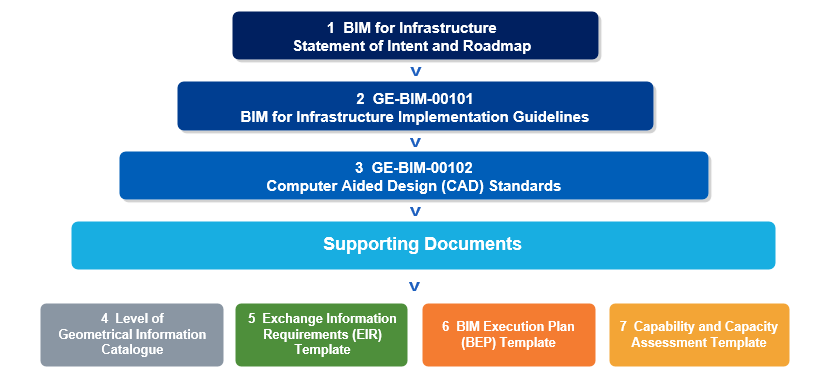
1. BIM for Infrastructure – Statement of Intent and Road Map
Defines TII’s commitments, objectives and roadmap for implementing BIM and Information Management (IM) across the asset lifecycle in line with the public sector BIM mandate.
2. GE-BIM-00101 BIM for Infrastructure Implementation Guidelines
Sets out the core guidelines for BIM implementation, including information exchange, roles and responsibilities, CDE requirements, naming conventions, LOIN, deliverables, procurement, security and digital delivery processes.
3. GE-BIM-00102 Computer Aided Design (CAD) Standards
Defines CAD standards and conventions to ensure consistency, interoperability and quality of project information.
4. Level of Geometrical Information Catalogue
Outline the expected levels of geometrical detail for project information models at each project stage.
5. Exchange Information Requirements (EIR) Template
For defining the Appointing Party’s information requirements.
6. BIM Execution Plan (BEP) Template
Describing how project teams will deliver and manage BIM and Information Management requirements.
7. Capability and Capacity Assessment Template
Used to assess the capability and capacity of delivery teams to meet project information requirements.