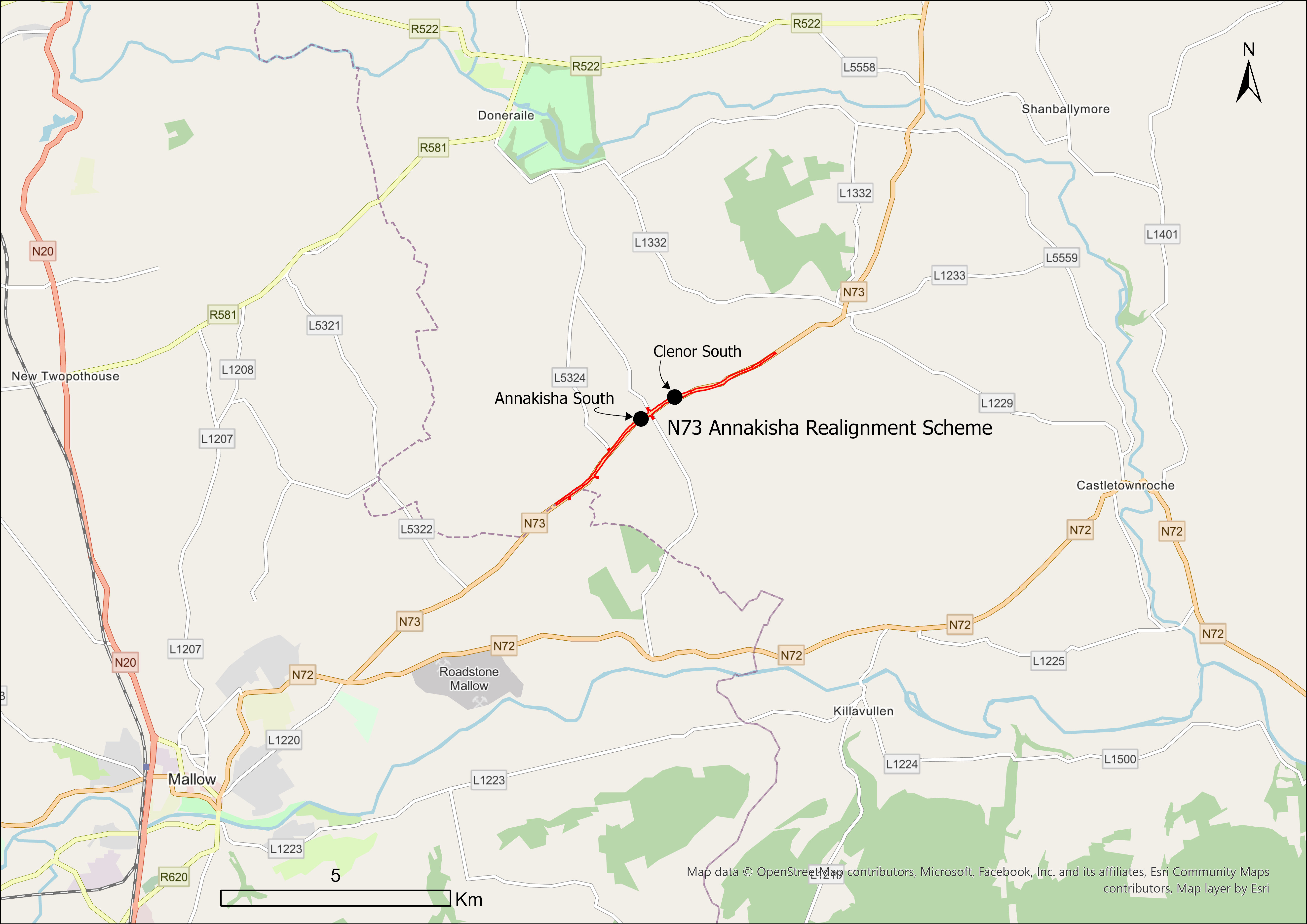
Archaeological investigations do not always examine the ancient past. Excavations in 2012 and 2019–2020, along the route of the N73 Annakisha Road Realignment Scheme, examined evidence of more recent rural craft and industry in the form of a well-preserved smithy at Clenor South 1 and 2, and a waste pit related to a former smithy at nearby Annakisha South 2 (Illus. 1). The Clenor South smithy was active from at least the late 18th century to the early 20th century, with a gap in use around the mid-19th century, when the Annakisha South smithy, just 300 m to the south-west, was temporarily in operation. We are fortunate that not only was there good archaeological evidence for the Clenor South smithy, documentary records for the smiths who worked and lived here also survive. Scientific analysis of the smithing waste from both sites has also been used to shed light on the economy of rural smithing during this period of great industrial change.
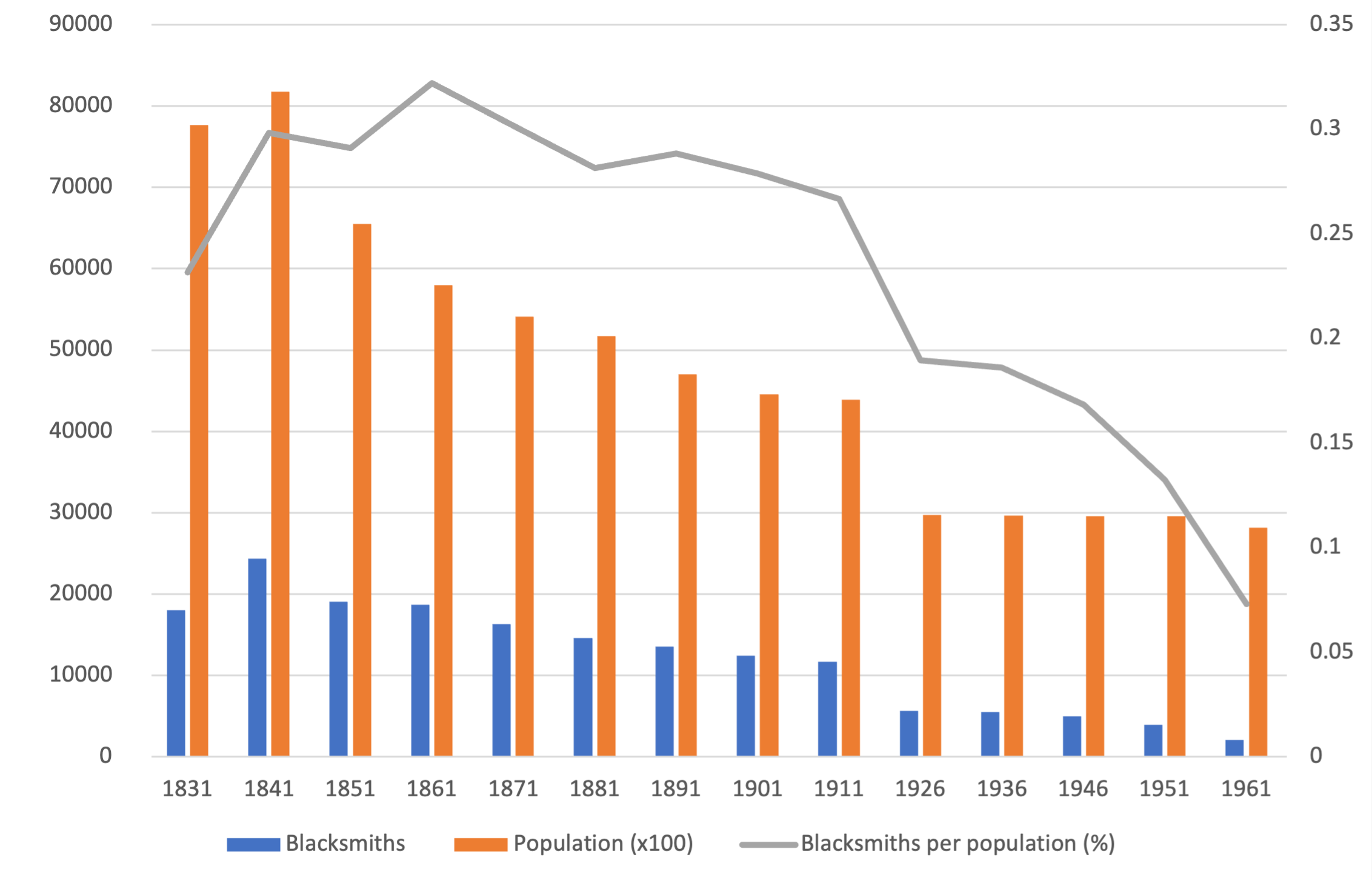
One of the pillars of the 19th-century industrial revolution, next to the application of steam power and advances in textile manufacture, was the innovation of removing sulphur from mineral coal—resulting in coke—which allowed it to be used (as a cheaper alternative to charcoal) in smelting iron. The resulting reduction in the price of iron led to it becoming a cheap and widespread material, and wrought iron was increasingly used for larger items such as cart tyres and gates. There was, correspondingly, an increase in the number of blacksmiths (Illus. 2) and smithies. The six-inch to one mile (c. 1830s) and 25-inch to one mile (late 19th to early 20th century) Ordnance Survey (OS) maps capture both the beginning and end of this prevalence of rural roadside smithies in Ireland.
Illus. 2: Blacksmiths and population derived from the censuses for Ireland 1831–1961.
The smithies
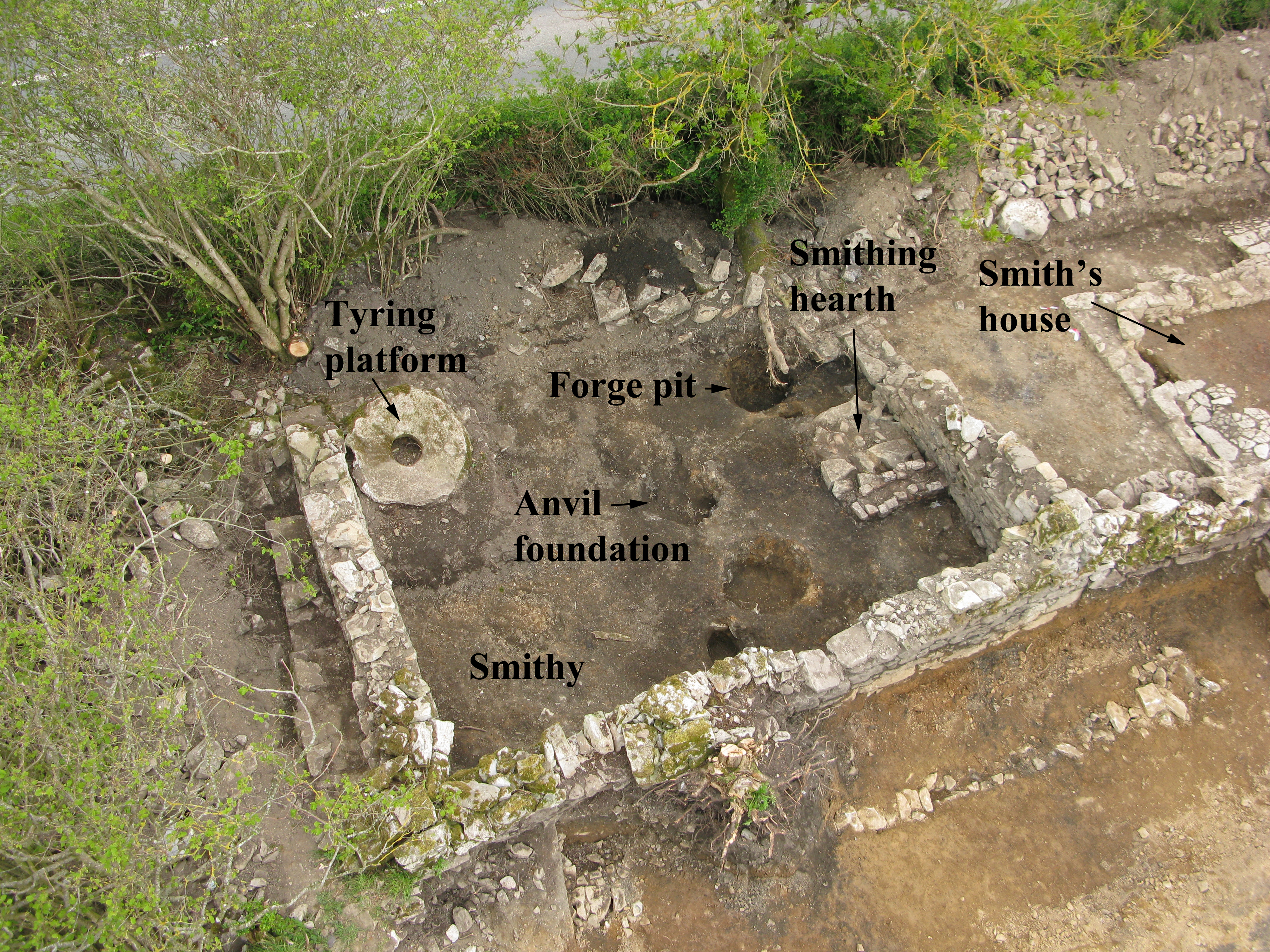
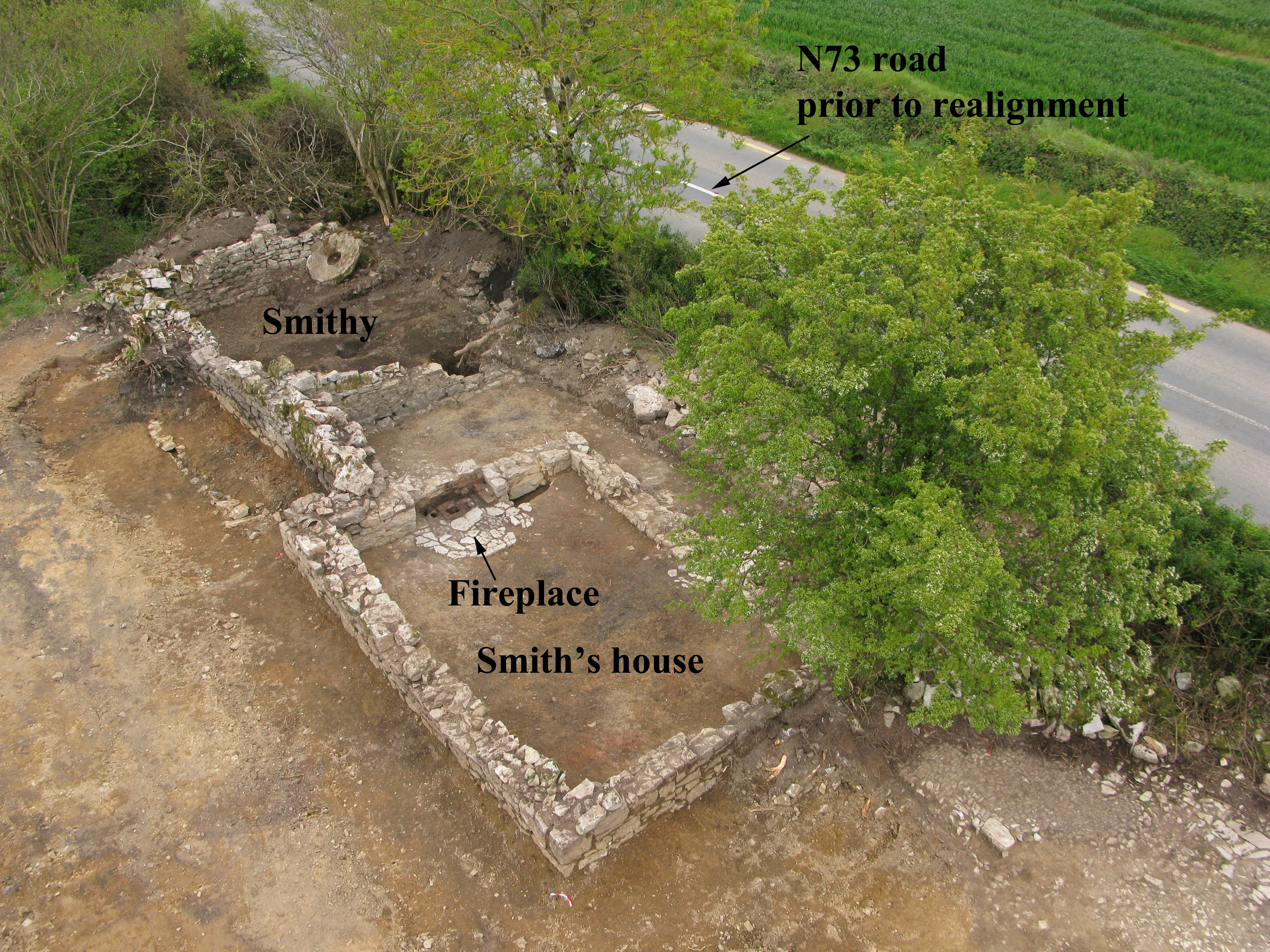
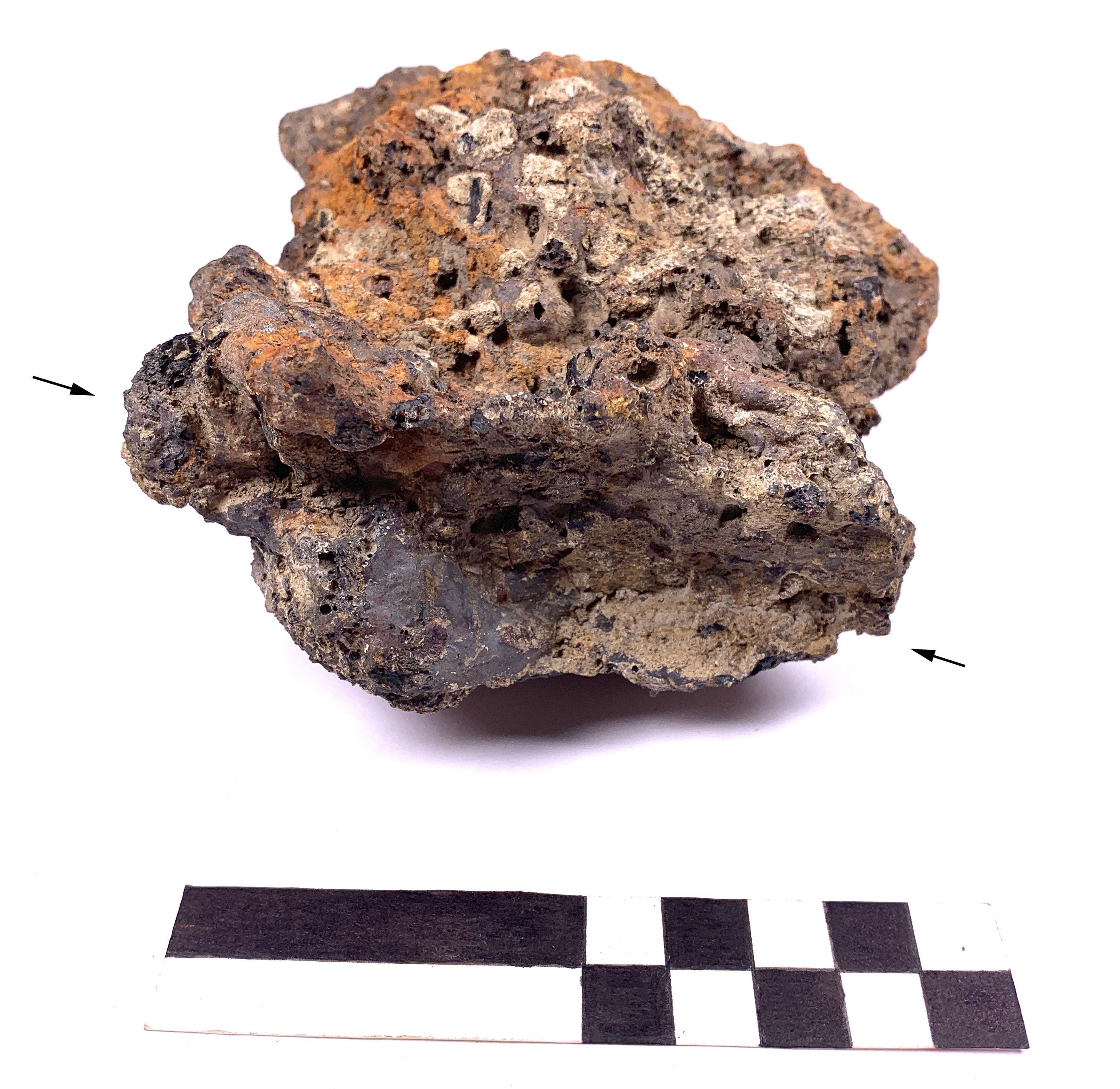
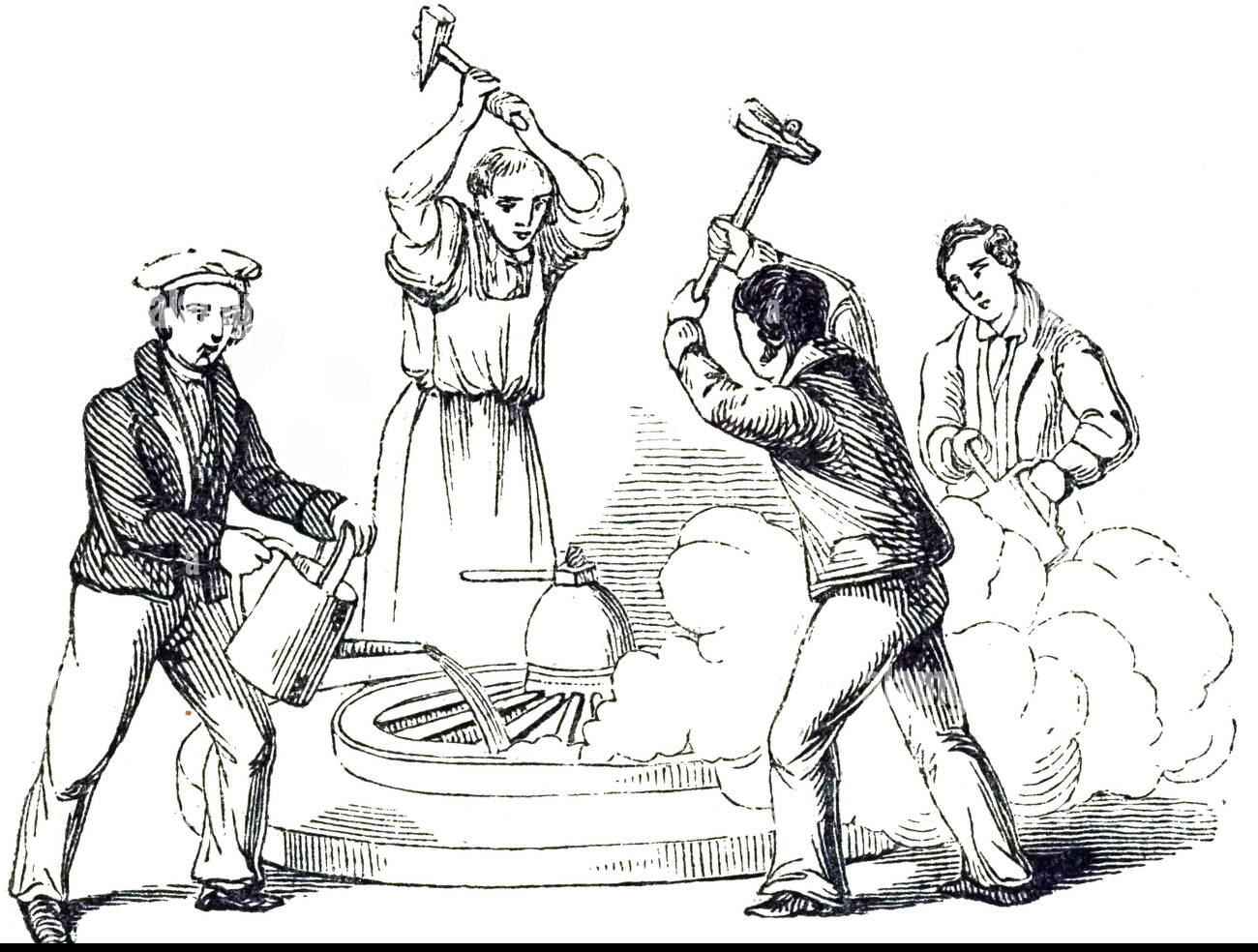
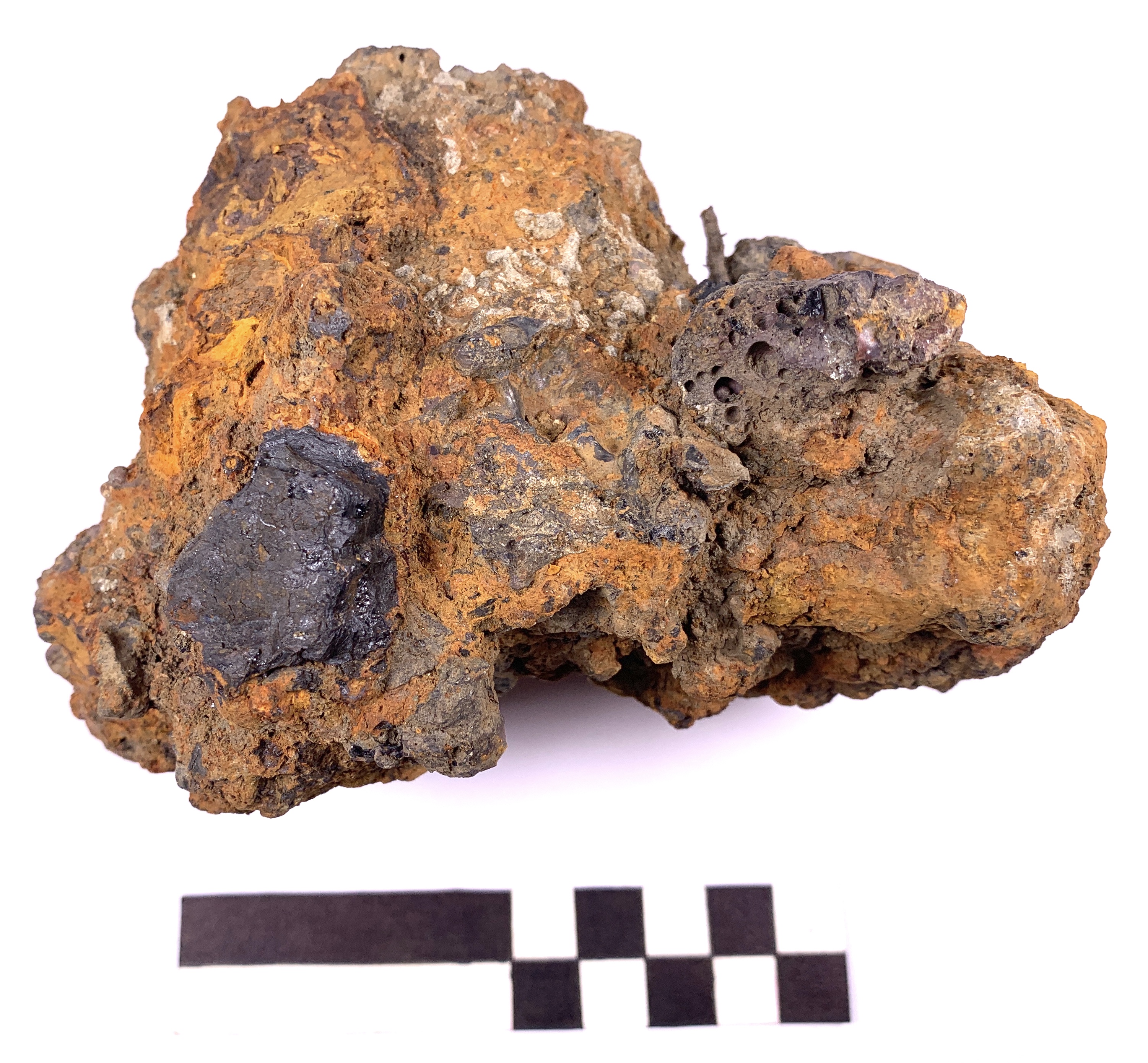
The Clenor South smithy survived as partly upstanding buildings (Illus. 3 and 4). The smithy was set at the south-east corner of a former late medieval moated enclosure. The smithy was a rectangular stone-built structure that measured approximately 6.8 m by 4.5 m internally and was built by the late 18th century; the front of the building was either truncated by the verge of the current N73 road, or open to the roadway. Four limestone-block walls and a supporting external wall stood to a maximum height of 1.8 m. The foundation base and part of an upstanding wall of a waist-level smithing hearth were uncovered inside the smithy, at its western end. Nearby, a waste pit with an adjacent post-hole and an anvil foundation with a double post-hole were cut into the natural clay floor of the smithy. The pit contained over 34 kg of slag (residue from ironworking as impurities are removed from the metal), including 46 smithing hearth cakes (iron-rich slag that accumulates at the bottom of a blacksmith’s hearth) (Illus. 5). The anvil foundation was 1 m in diameter and was surrounded by waste, comprising a compact black deposit (0.1 m thick) that had fallen to the floor as the smith worked. A large number of horseshoes were found above this deposit hinting that these were abandoned after the smithy’s last use. The waste pit, anvil foundation and post-holes were sealed by a compact deposit of metalworking debris, which also covered the majority of the smithy floor, scattered after it went out of use. A concrete tyring platform or binding stone (1.4 m in diameter), used for fitting metal ‘tyres’ or rims onto wooden wheels, was found within the smithy. The tyring platform still retained an iron band around its circumference. The axle of the cartwheel would have been placed in the central perforation (0.35 m in diameter) to hold the wheel in place, and then the iron rim was easily accessible for repair or to be remade (Illus. 6). The walled remains of the Clenor South smithy, along with the tyring platform, are outside the newly realigned N73 road and have been preserved in situ.
Unlike at Clenor South, where the smithy was fully exposed, at Annakisha South 2 only features ex-ternal to the smithy were exposed within the excavation area. Of these, a few contained metalwork-ing evidence that likely derived from the smithy, the most informative being a single waste pit.
Illus. 3: Aerial view of excavated smithy at Clenor South. Note tyring platform. South to top of image (Photo: Airshots).
Illus. 4: Aerial view of excavated smithy at Clenor South with domestic dwelling in foreground. South-east to top (Photo: Airshots).
Illlus. 5: Smithing hearth cake from Clenor South 2, with imprint of iron tuyere (arrowed) (Photo: Paul Rondelez).
Illus. 6: ‘Hooping’ or tiring’ a wheel from a mid-19th-century woodcut (Penny Magazine 1841, 505).
Evidence for smithing activities
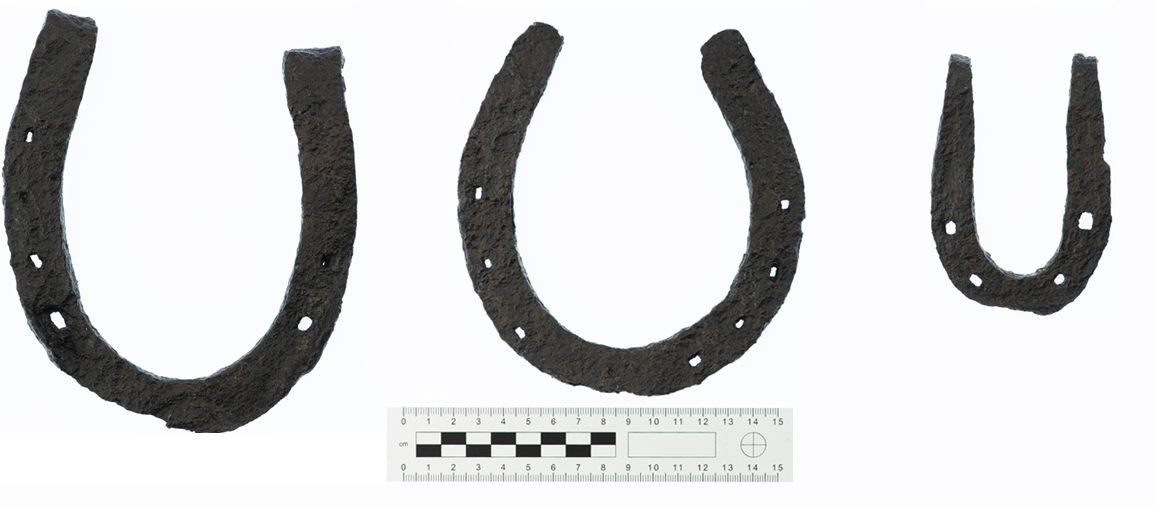
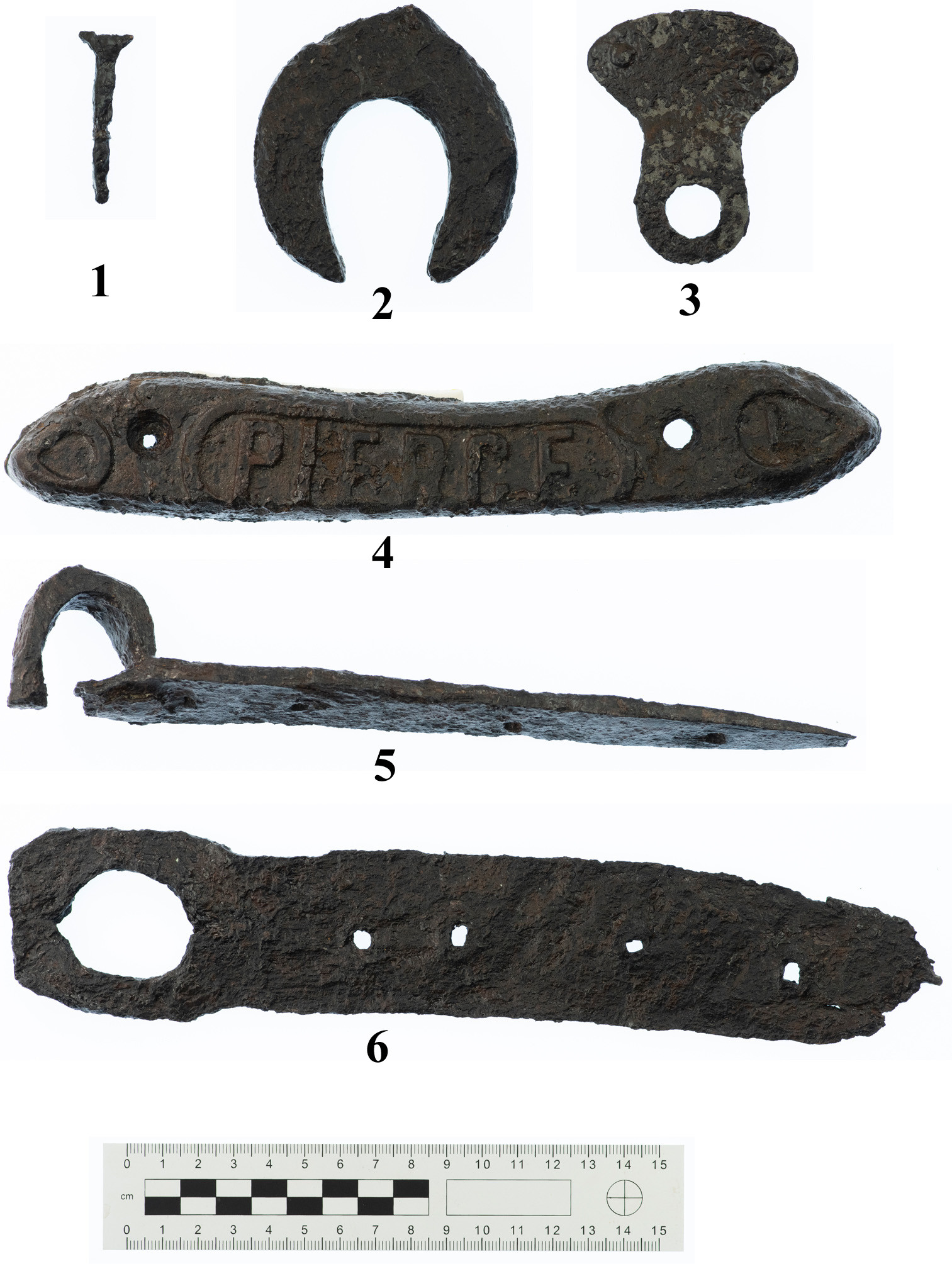
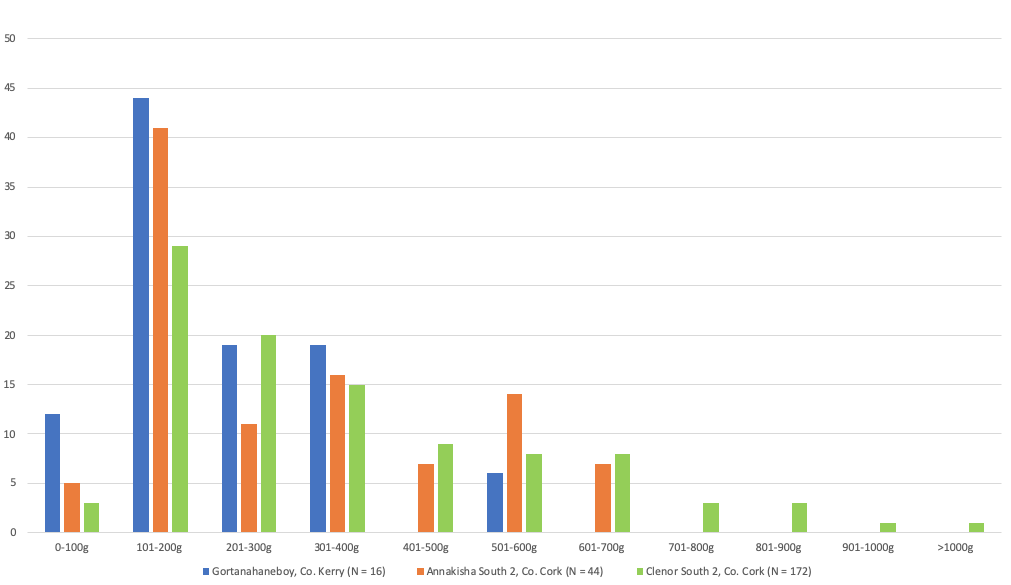
Large numbers of predominantly 19th-century horseshoes and some horse-related tools and fittings were also recovered, dumped into a ditch immediately adjacent to the Clenor South smithy (Illus .7 and 8). An interesting account of the horse-shoeing evidence from the two sites and the role of the smith in rural Ireland has been published elsewhere (Maguire et al. 2023). The ditch also yielded an additional 172 smithing hearth cakes. Each cake represents the residual remains of a single forging operation, and its weight is related to the amount of iron forged and the forging techniques used. Forge welding, for example, leads to higher loss of iron and higher slag formation. Both the maximum and average weights of the cakes from Clenor South are larger than those recovered from the waste pit at Annakisha South 2, and substantially so when compared to the cakes from a late 18th-century smithy excavated at Gortanahaneboy East on the N72 Stagmount Bends Road Improvement Scheme, Co. Kerry (Illus. 9). Due to the increased availability of iron towards the end of the first half of the 19th century, larger, more complex iron objects became commonplace, including wrought iron gates and agricultural machinery. In addition to the production and repair of such objects, the shoeing of horses and other smaller jobs remained the staple work of the rural smithy. This is reflected in a study (Wallace 2005) of the surviving bills of a rural blacksmith working in County Limerick between 1864 and 1899. By far, most of the work related to shoeing horses, with bigger jobs only occasionally carried out, many relating to new types of farming machinery, such as mowing machines—first used in Ireland in County Clare in 1833—and threshing machines—that came into common use in the east of Ireland in the 1830s. The increase in smithing hearth cake weights in the later 19th century at Clenor South is most likely the result of more and larger pieces of iron in use in rural forging at that time.
Illus. 7: Examples of different sized horseshoes for a range of horse and pony types from the Clenor South smithy (Photo: Dylan Duane Roche).
Illus. 8: Examples of iron objects from Clenor South. 1: Horseshoe nail. 2: Possible 17th-century style proto horseshoe or uncompleted trial piece. 3: Peltate (shield-shaped) object; probably a fitting for a handle on a vessel such as a cauldron. 4: Plaque bearing the name Pierce. The Pierce Foundry, founded in Wexford in 1839, manufactured horse-drawn farming vehicles, which were shipped worldwide. 5: Door hinge fragment. 6: Nail maker. The nails were driven through the various-sized holes in the flat plate, which, in this case, had a convenient loop allowing it to be hung on the wall of the forge when not in use (Photo: Dylan Duane Roche). Illus. 9: Smithing hearth cakes (%) per weight category from excavated iron-working sites at Gortanahaneboy, Co. Kerry, and Annakisha South 2 and Clenor South 2, Co. Cork.
The iron used in the smithies at Annakisha South and Clenor South was wrought iron. It was created in the iron-producing centres in England and Wales by refining (‘puddling’) cast iron made in furnaces into forgeable metal. This type of iron, like all iron before it, contained impurities that were removed during the smithing process, which contributed to the formation of the smithing hearth cakes. At the end of the 19th century, steel-making furnaces became common, producing ‘mild steel’ which gradually replaced wrought iron. As mild steel does not contain slag, the waste, known as ‘cinder’ or ‘clinker’, is much lighter and consists of burnt fuel impurities and materials from the hearth. It was this type of material that was excavated from the most recent (early 20th century) floor levels at Clenor South.
Inclusions in the smithing slag give a good insight into the changing source of fuel in both smithies. Coal was burnt during the 18th to early 19th century use of the smithy at Clenor South and at Annakisha South, both the dull bituminous and shiny anthracite varieties (Illus. 10). At least some of the coal might have been mined locally, as Lewis (1837, 339) records the sinking of a shaft in Clenor parish on a deposit of ‘culm’ (bituminous coal) ‘from which some fine specimens were obtained’, although it is unclear if this led to the actual mining of the coal. The Duhalla culm mines (c. 30 km to the west) ceased operation in 1883, and this may have played a part in the switch to porous coke use at Clenor South in the early 20th century. Interestingly, the slag from the later 19th-century use of the Clenor South smithy mainly had inclusions of charcoal, with some anthracite coal. Little research has been done on the use of charcoal at that late period but a record in the National Folklore Collection of a spade mill at Delvin, Co. Westmeath, using charcoal in the 1930s suggests it was still produced and used in iron-working into the 20th century in certain areas of the country. The early 20th-century waste at Clenor South included mainly porous coke as fuel, which is typical of the wider switch over to this fuel type around this time, signalling a step forward in industrial processes.
Illus. 10: Smithing hearth cake with large inclusion of anthracite coal evident (Photo: Paul Rondelez).
The smith’s home
Adjacent to the Clenor South smithy building, a house had been constructed at a slightly lower level to, and set back 0.5 m from, the smithy. This was probably the home of the smith and his family and was a little smaller than the smithy, with internal dimensions of 6.6 m by 4.4 m. The six upstanding walls were constructed of a mix of roughly hewn and faced limestone blocks. The building contained a fireplace with red brick detail and a recess for a fire fan; there was stone flag flooring in front of the fireplace and at the entrance.
Two splayed external walls stood at either side of the smithy and house, forming an entrance courtyard, corresponding to walls indicated on the 1903 OS map. This entrance, no doubt, facilitated roadside access for the carts, carriages and horses of the smith’s customers.
It is perhaps significant that the townland of Ballygown that lies 1.2 km north-east of the Clenor South smithy, is Baile Uí Ghabhann in Irish, potentially meaning ‘the smith’s town’ (logainm.ie), hinting at the likelihood that there has been a long tradition of metalworking in the general region, perhaps dating back to medieval times. During the mid-15th to mid-17th centuries, Clenor South would have been part of the estate of Castle Kevin, controlled by the 13th to 14th century Anglo-Norman planter Roche family. According to Grove White (1905–25, Vol. 2, 103–4), William Thornhill was granted the castle in 1666 after it was forfeited by the Roches during the Cromwellian wars, and it was held by the Thornhill family until the mid-19th century. By 1851, the lessor of the forge at Clenor South was Thomas Keppel, while either Pierce Nagel or Charles Roche was the lessor of the land at Annakisha (Griffith’s Valuation).
The smithy in a time of national resistance
The smith at Clenor South may have been engaged in making weapons as well as agricultural and horse-related items, and it is rumoured that pikes were made there for the Irish Rebellion of 1798, as related by Mr James Buckley (Council Member of the Cork Historic and Archaeological Society) to Colonel Grove White (1905–25, Vol. 1, 194) in 1913:
... about 200 yards from the present Catholic Church of Annakissy [sic], stands a smithy which is said to be 200 years old at least. In 1798 a detachment of infantry was ordered to search the houses in the district for arms. A sentinel was sent to each house in advance of the search party. The soldier who happened to be on guard before the smithy entertained fellow feelings with the peasantry, and said to the blacksmith that if he wished to hide any weapons now is the time. This was a most welcome hint to the smith, who immediately concealed a number of pike-heads, which he had finished making, in a stone water trough which is used in smithies for cooling purposes. He then covered them with “hob” or refuse from the forge fire. The discovery of these weapons would have meant certain and perhaps immediate hanging to the blacksmith. The soldiers searched all corners of the forge and through the roof, but overlooked the trough, and departed without finding any unauthorised object.
It is reported that in 1895 the then smith Joseph Hunter found some pikes hidden at the back of the ‘fireplace’ (likely the waist-level hearth) in his smithy (ibid.). One of the pikes is said to have subsequently been hanging in Grove White’s hall at Kilbyrne, but, despite enquiries, the present whereabouts of these items is no longer known.
The social history of the smiths and smithies
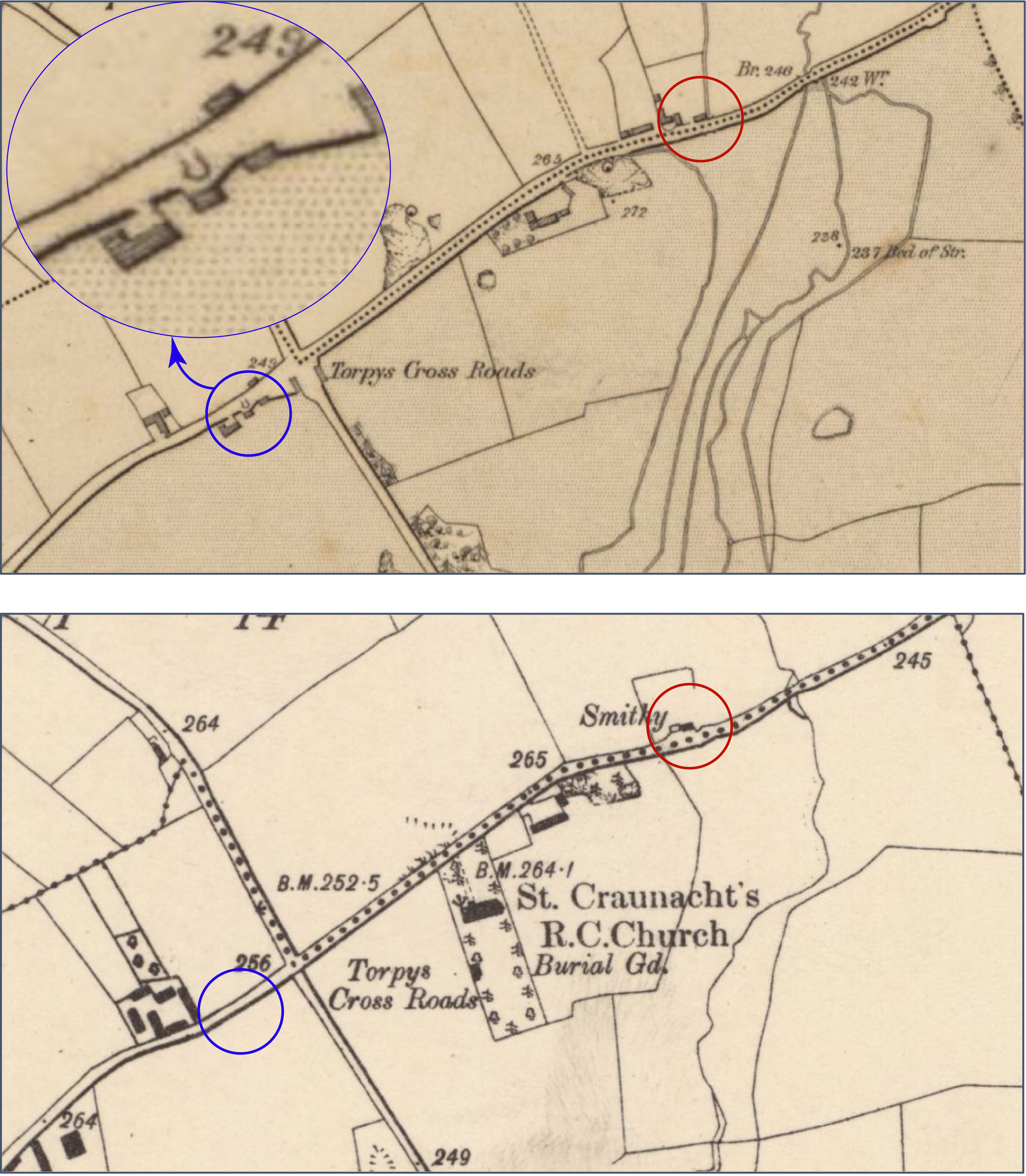
There was, seemingly, an intermission in the use of the Clenor South smithy, as the OS map of 1840 denotes the presence of the Annakisha South smithy by the use of a horseshoe symbol at nearby Torpy’s Cross, adjacent to the excavated site Annakisha South 2 (Illus. 11). There is no such symbol at Clenor South, perhaps a reflection of the focus of smithing moving to the nearby crossroads in the earlier 19th century. The Clenor South smithy seemingly came back into use in the mid-19th century though, as the Griffith’s Valuation tenure book of 1844 records a smithy at Clenor South which was occupied first by Michael Crow and subsequently by Cornelius Herlihy, while the published Valuation (1851) lists Michael Hickey as leasing the smithy. Neither of these Valuation documents record a smithy at Annakisha South and it is unlikely that two smithies would have operated simultaneously so close together. In the 20th century, the aforementioned Joseph Hunter was listed in the 1901 census as a blacksmith and living in nearby Ballygown townland; he is recorded as a widower, aged 32, with children, William aged 8, David aged 6. In the 1911 census, Joseph Hunter (now recorded as remarried, aged 46, with children, William aged 17, David aged 16) was resident in Annakisha South and his profession was blacksmith. Joseph Hunter continued as blacksmith at Clenor South (Grove White 1905–25, Vol. 1, 194) and ceased work there in the early 20th century as a family member of his had a smithy at nearby Shanballymore (Tadhg Ó Raghaill, pers. comm.). This closure of the Clenor South smithy early in the 20th century matches the significant downward trend in blacksmiths per head of population (Illus. 2).
Illus. 11: Smithies at Annakisha South (blue circle) and Clenor South (red circle) on the OS maps (six-inch to one mile, Cork - Sheet 25). Top: first edition, surveyed 1841, engraved 1844, printed 1844 (https://maps.nls.uk/view/246834556): Bottom: revised edition 1903–04, published 1905 (https://maps.nls.uk/view/247666824). Reproduced with the permission of the National Library of Scotland, licensed under CC BY (NLS).
Epilogue
A slight pre-construction change to the design of the N73 Annakisha Road Realignment scheme has allowed for the Clenor South smithy building to remain in place. Readers can learn more from several articles published about the scheme (Hull 2020; Hull & Ruttle 2024; Maguire et al. 2023; Ruttle 2014).
This paper is dedicated to the memory of Kieran McKeone (†), former Senior Executive Engineer, National Roads Design Office, Cork County Council.
Further reading
Grove White, Col. J 1905–25 Historical and topographical notes etc. on Buttevant, Castletownroche, Doneraile, Mallow and places in their vicinity, 4 Volumes. Guy & Co. Ltd, Cork.
Hull, G 2020 ‘Continuity of place: initial results of archaeological investigation in advance of the N73 Annakisha Realignment Scheme’, Mallow Field Club Journal, Vol. 38, 127–40.
Hull, G & Ruttle, E 2024 ‘From first farmers to roadside forge: archaeological discoveries from two N73 road re-alignment schemes, in north County Cork’, Journal of the Cork Archaeological and Historical Society, Vol. 129, 31–73.
Lewis, S 1837 A Topographical Dictionary of Ireland, comprising the several counties, cities, boroughs, corporate, market, and post towns, parishes and villages, 2 volumes. S. Lewis & Co., London.
Maguire, R, Taylor, K & Maguire, J 2023 ‘Forging rural heritage: observations from recent archaeological excavations at Clenor South and Annakisha South, County Cork, Ireland’, Cheiron: The International Journal of Equine and Equestrian History, Vol. 3, No. 1, 85–101.
Penny Magazine 1841 ‘A day at a coach factory’, The Penny Magazine of the Society for the Diffusion of Useful Knowledge, Vol. 10, 501–8 (Dec 1841).
Ruttle, E 2014 ‘A County Cork smithy’, Archaeology Ireland, Vol. 28, No. 1, 23–5.
Wallace, P F 2005 ‘Documentary evidence of the work of a country forge after the Great Famine’, in T Condit & C Corlett (eds), Above and Beyond: essays in memory of Leo Swan, 473–89. Wordwell, Bray.